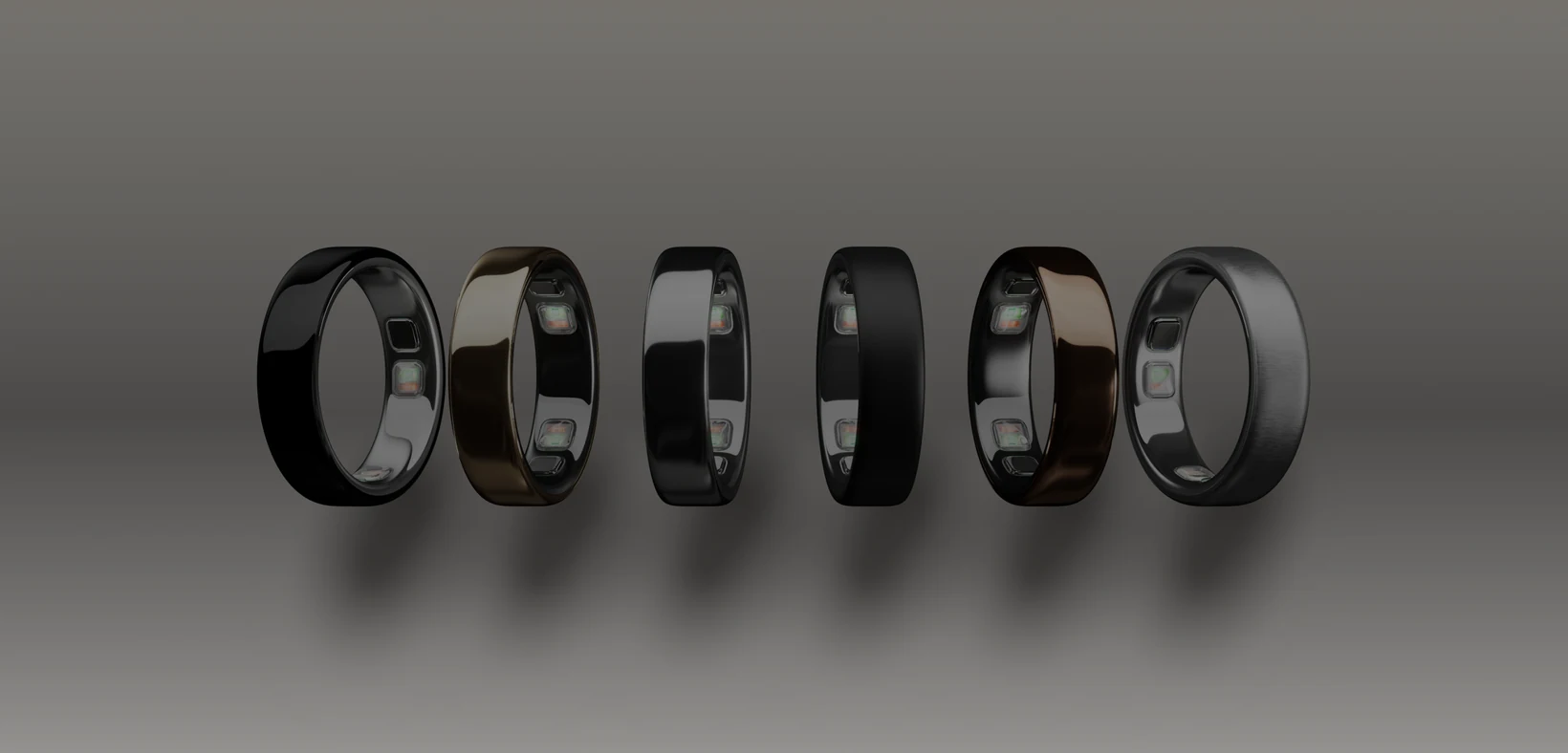
The Oura Ring 5 starts at $399. That is accurate. It is also not quite the whole price.
Choose Silver or Black and the current hardware starts at $399; several other finishes sit at $499. Then there is Oura Membership, currently $5.99 a month or $69.99 a year in the U.S. New members get the first month free. If you stop paying, Oura says the ring and app still work, but the insights, personal health data and benefits become much more limited.
None of this is hidden. What Oura’s IPO filing does is make the relationship between those two prices unusually visible.
For the nine months ended June 30, 2026, Oura reported $974 million in hardware revenue and $240.5 million in membership revenue. Membership represented roughly 20% of total revenue and carried an 89% gross margin.
The more revealing comparison is the growth. Membership revenue rose 121% from the same period a year earlier. Hardware revenue rose 65%. Membership’s share of Oura’s revenue increased from 16% to 20%.
The ring still brings in most of the money. The relationship that begins after the ring sale is growing faster.
Oura also says that historically more than 94% of ring activations convert to Paid Members.
In other words: the membership is not a little software garnish sprinkled on top of an expensive titanium ring. It is part of the product’s economic architecture.
That makes Oura’s IPO filing interesting even if you have absolutely no desire to buy OURA shares. For anyone deciding whether to buy the ring, the filing sharpens a much more useful question:
What, exactly, are you paying Oura to keep doing after you already own the hardware?
The Ring Is Only the First Price
Oura has become very good at making a health tracker feel less like equipment.
Ring 5 is full titanium, comes in six finishes and is 40% smaller by volume than Ring 4, according to Oura. The company’s current guidance puts typical battery life at roughly six to nine days, depending on settings, size, battery age and use.
That matters because smart rings have a basic job that spreadsheets tend to ignore: You have to want to keep wearing them. A wearable can have gorgeous charts, sophisticated algorithms and enough sensors to make a NASA intern misty-eyed, but if it is annoying on your finger by Thursday, the data story ends there.
Oura’s hardware pitch is tangible: a small, jewelry-adjacent object designed to disappear into daily life while collecting a continuous stream of signals.
But the filing shows that Oura does not want the story to end with the object.
The ring measures.
The membership interprets.
That distinction is increasingly the heart of the value proposition.
What the Membership Is Actually Selling
Oura describes membership as the layer that turns the ring’s measurements into personalized insights across sleep, readiness, activity, stress and more.
Its current membership page says users without an active subscription still retain basic ring-and-app functionality, but receive a much more limited version of the data and insight experience.
That changes the way the purchase should be evaluated. If the ring were simply a sensor package, you could compare it mostly on material, battery, comfort, accuracy and price.
But Oura is selling a continuing interpretation service. The value is supposed to grow from context: your baseline, your patterns, your history, the way one night relates to the last thirty, and the way the software turns a pile of measurements into something you might actually do differently tomorrow morning.
The filing makes that strategy legible in numbers.
Oura reported 5.0 million Paid Members at June 30, 2026. Its weighted-average 12-month Paid Member retention was approximately 85%, and 63% of new members in the nine months ended June 30 started on an annual plan.
That answers an obvious skeptical question: fine, most activated rings convert to membership. But do people stay? A substantial majority appear to make it through the first twelve months as paying members.
Those figures do not prove that every subscriber is happy, that the advice is worth the fee for every person, or that an 89% membership gross margin means the service is overpriced. Corporate economics cannot answer a personal value question that neatly.
They do show that Oura has built a business in which the recurring relationship matters strategically, not just the object that begins it.
The filing is unusually blunt about the model. Oura says hardware gross profit is intended to offset the cost of acquiring the customer, while membership extends that customer’s lifetime value afterward.
Translated out of investor language:
The ring sale begins the economics.
The subscription keeps them going.
The Category Now Contains Competing Ownership Models
Oura is no longer competing only against watches or the idea of wearing nothing at all. It is competing against other rings whose economics are deliberately different.
RingConn’s Gen 3 currently lists at $349 and says no subscription is required, although its U.S. product page was marked out of stock at publication.
Ultrahuman’s Ring PRO lists at $479 and says access to ring data does not require a recurring subscription. The current product page remains in its preorder/shipping rollout and now says shipping begins October 10.
That does not make either ring better.
It does not establish equivalent accuracy, equivalent coaching, equivalent algorithms or equivalent usefulness. Those are separate questions and would require genuinely comparable evidence.
But it makes the ownership model impossible to ignore.
The smart-ring category now contains competing models that say, in effect:
Buy the device without a required recurring fee for core ring-data access.
Or:
Buy the device, then keep paying for the fuller interpretation layer.
Neither model is inherently virtuous. The question is which one is selling the thing you actually want.
How Much Does Oura Ring 5 Actually Cost Over Three Years?
A useful way to judge Oura is to split the purchase into two columns.
The first is the object.
You are paying for the titanium, size and comfort, battery life, sensors, finish, manufacturing, charging experience and the fact that it looks sufficiently normal that you may wear it while doing everything from sleeping to going out to dinner.
The second is the relationship.
You are paying Oura to keep organizing the data, remembering your history, detecting patterns, releasing software features and translating a quiet stream of biometric measurements into recommendations and context.
That second column is where the subscription lives.
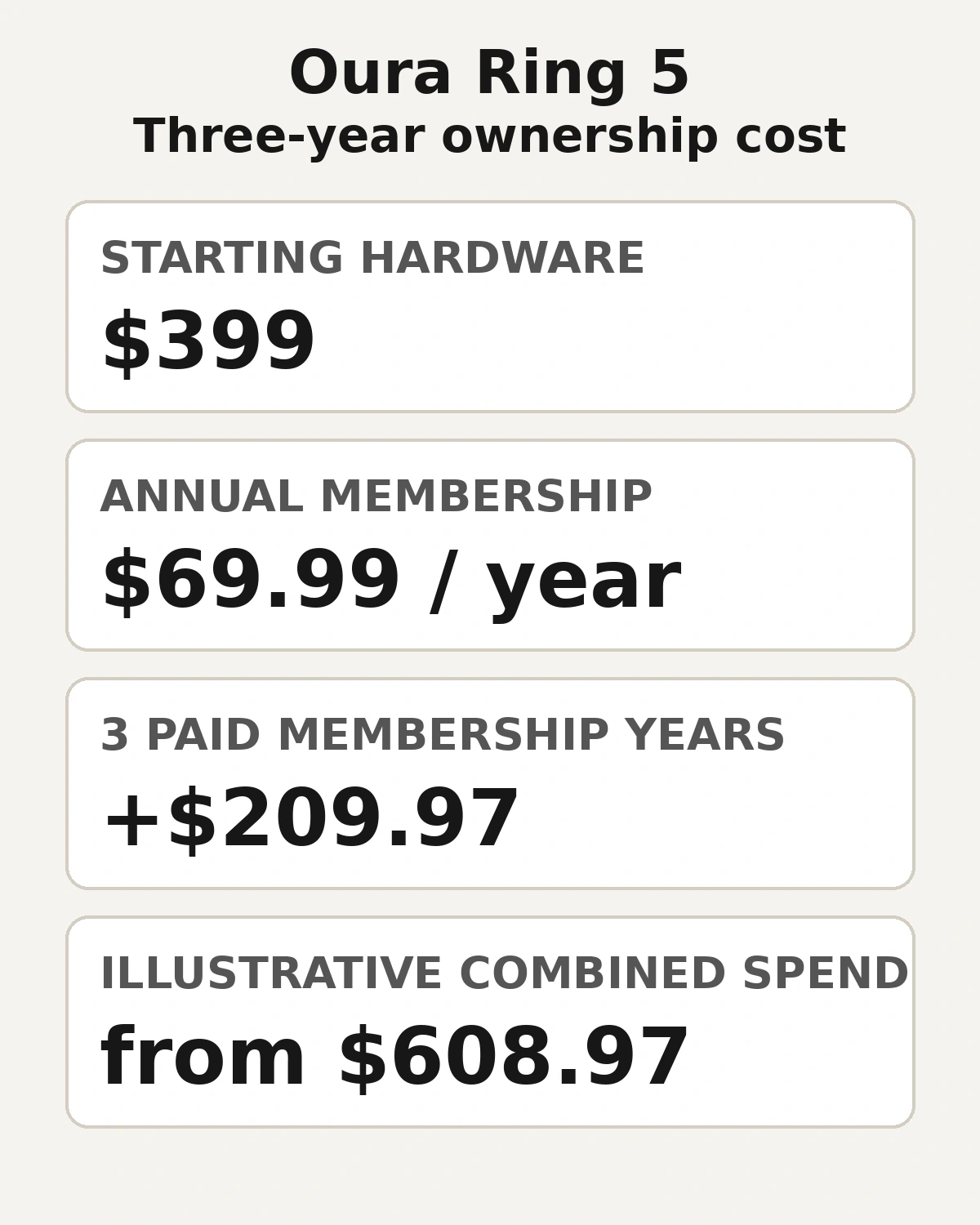
At the current U.S. annual rate, each paid membership year adds $69.99 to the ownership cost after the trial period.
Three paid membership years would add $209.97 at today’s price, before tax and assuming the fee does not change.
So a $399 Ring 5 plus three paid years of current annual membership would represent about $608.97 in combined hardware and membership spend.
A $499 finish would put the same illustrative total around $708.97.
Those are not promises about future pricing. They are simply a better way to see the purchase you are making today.
By comparison, RingConn lists Gen 3 from $349 without a required subscription, though the U.S. page was out of stock at publication. Ultrahuman lists Ring PRO at $479 and says there is no recurring fee required for ring-data access, though the product is still in preorder and now says shipping begins October 10.
Again, this is a comparison of ownership economics and current acquisition state, not a declaration of feature parity.
The Ownership Question in One Glance
| Oura Ring 5 | RingConn Gen 3 | Ultrahuman Ring PRO | |
|---|---|---|---|
| Starting hardware price | $399 | $349 | $479 |
| Required recurring fee for the stated full/core ring experience | $5.99/mo or $69.99/yr for full Oura experience | None required under current model | None required for ring-data access |
| Without recurring payment | Ring works, but Oura says health data, insights and benefits become much more limited | Current model does not require one | Current ring-data model does not require one |
| Current acquisition state | Available from Oura | U.S. page out of stock at publication | Preorder; shipping begins October 10 at publication |
| The value question | Is Oura’s continuing interpretation worth paying for? | Is the one-time model worth the feature tradeoffs? | Is the higher upfront price preferable to a required membership? |
Prices, plans and availability are current public information and can change. The table compares ownership economics and acquisition status, not accuracy or feature parity.
The Real Premium May Be Memory
There is a subtler reason Oura’s membership model can work.
The longer you use a health platform, the more context accumulates.
Yesterday’s resting heart rate is useful. A year of personal baselines, routines and deviations can become more useful because the software has more history to interpret.
Oura’s investor case depends partly on exactly that idea: that longitudinal context makes the membership more valuable as the system learns from a member’s history.
That helps explain why the retention number matters.
An 85% weighted-average 12-month Paid Member retention rate does not tell us why any individual stays.
It does show that the relationship persists for a large share of paying users.
And over time, that creates a form of switching friction that has nothing to do with physically removing a ring.
The object can be replaced in a day.
The accumulated context is harder to recreate somewhere else.
That does not mean Oura is deliberately locking users in, and the filing does not prove how strongly individual consumers experience this effect. Oura also allows users to export their data, including when they are not actively subscribed.
But it does suggest something important about where premium wearables are heading.
The moat may not simply be a better sensor.
It may be becoming the continuing relationship between the sensor, the software and the history of the person wearing it.
And competitors with no-required-subscription models are placing a different bet: that buyers will increasingly expect sophisticated health tracking without putting the fuller interpretation of their data behind another annual bill.
So, Is Oura Worth It?
For the person who opens Oura every morning, cares about the interpretation layer and wants the software to keep turning long-term patterns into something actionable, the membership may be the point rather than the nuisance.
For the person who mainly wants health trends, dislikes recurring fees, changes devices frequently or simply believes purchased hardware should come with a fuller ongoing data experience without a required recurring fee, the existence of current no-required-subscription alternatives makes Oura’s economics harder to wave away.
And for the design-first buyer deciding whether the prettier finish is worth another $100, there are really two premium decisions hiding in one purchase:
How much do you want to spend on the object?
And do you want to keep spending on the relationship?
Oura’s IPO filing does not settle that decision.
It does something more useful.
It makes the second price impossible not to see.
Oura Ring 5. Image: Oura. Source