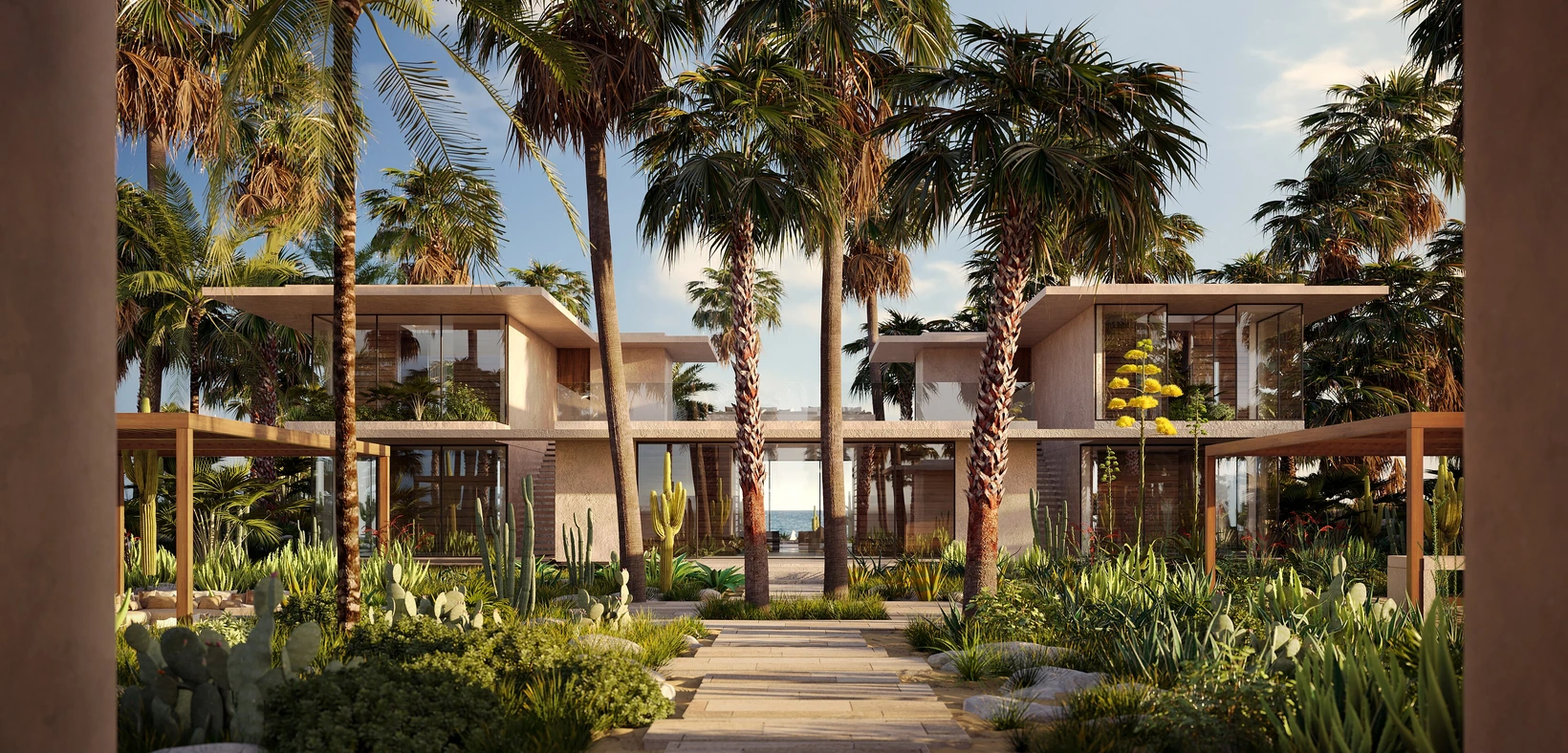
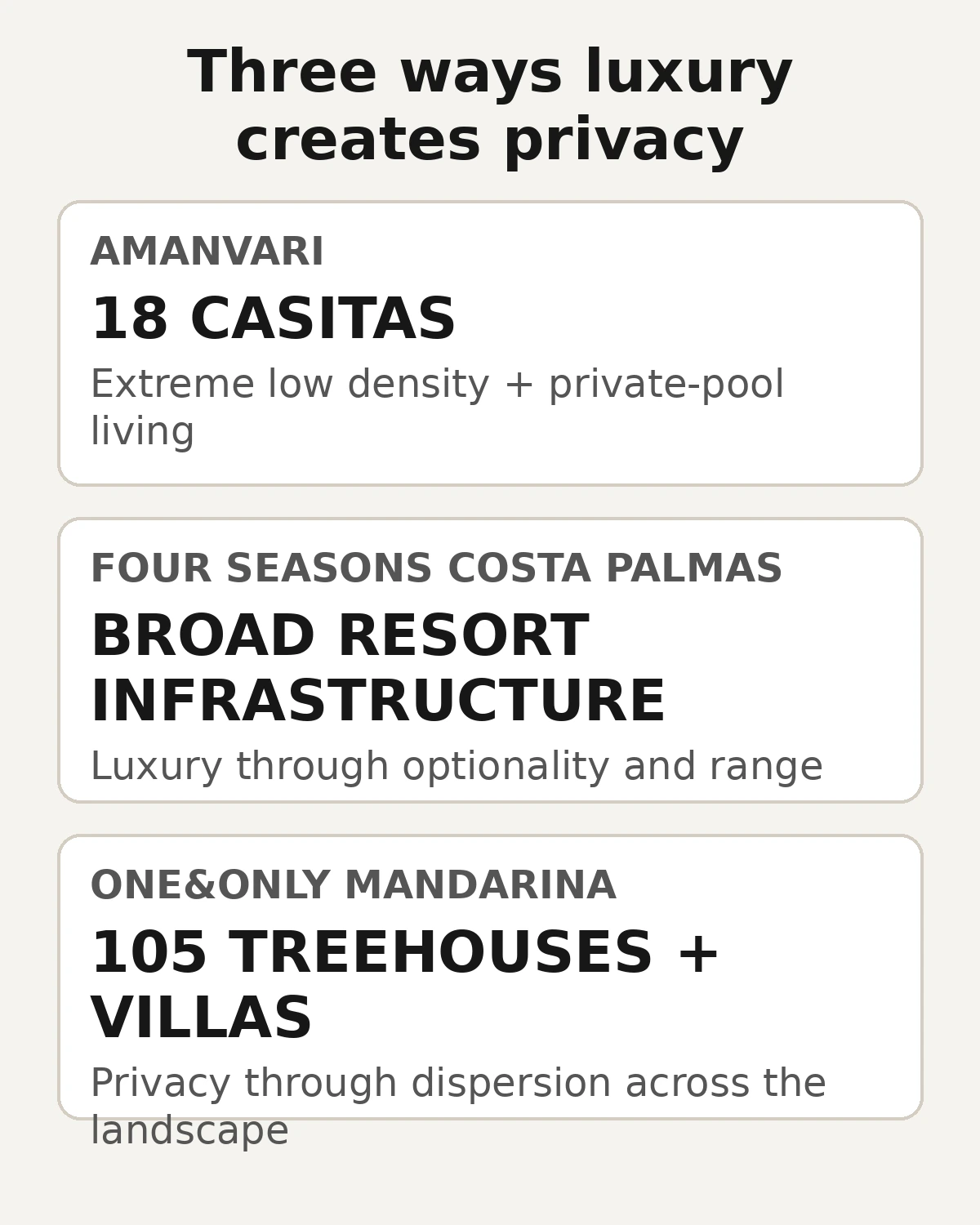
Amanvari, Aman’s new resort on Baja’s East Cape, has 18 standalone casitas. Compare Amanvari with Four Seasons Costa Palmas and One&Only Mandarina, and you are really comparing three luxury models: extreme scarcity, broad full-service optionality and privacy through dispersion.
Each Amanvari casita is 82 square metres with a private heated pool, terrace and outdoor shower. More importantly, the entire property has been designed around the idea that a guest should feel unusually separated from the ordinary traffic of resort life.
The price is equally concentrated. Late-summer public rate tracking placed Amanvari around $5,690 for a typical night including taxes, while a September first-person review contextualized its stay at roughly $7,000 a night. Dated fall snapshots for Four Seasons Costa Palmas and One&Only Mandarina have appeared much closer to roughly $1,050 all-in and about $918 respectively. Those are not same-date, same-room, same-cancellation-policy quotes. Hotel rates move constantly, and the Mandarina comparison is in a different Mexican destination. The numbers are useful only for scale: Amanvari is operating in a radically higher nightly tier.
So the question is not whether 18 keys make a prettier spreadsheet. It is whether low density, service intensity and concentrated privacy create a meaningfully different product.
The Price of Fewer People
If hotel value were measured by the number of facilities immediately outside your room, Amanvari would have a difficult argument to make. Four Seasons Costa Palmas, in the same East Cape development, offers a private marina, golf, multiple pools, spa facilities, a swimmable beach and broad dining and activity infrastructure. Amanvari is not trying to beat that list. Its 18-key scale is the proposition.
Every guest begins with a standalone casita and private heated pool, positioned in elevated, estuary or beachfront settings. The small key count does not just change the economics. It changes the product. Low density is not an upgrade category added after the room is booked. It is built into the inventory model.
Aman’s current stay information also makes the premium more concrete. Depending on the booking terms, standard inclusions include daily breakfast, in-room refreshments and nonalcoholic beverages, fitness access, bikes, non-motorized watersports, daily guided wellness activities and custom itinerary planning. Those inclusions do not turn a $5,000-plus nightly rate into conventional value. They do show that the proposition is not simply an empty landscape around an expensive room.
Amanvari Built Isolation Into the Plan
The architecture makes that intention less abstract. Elastic Architects, which designed the resort with initial contributions from Heah & Co., describes Amanvari through the idea of “islandness.” The firm drew on Baja’s peninsula geography and the sensation of remote landforms, using elevated spaces, water and separation to create a feeling of a private oasis.
The design moves from desert arrival toward lagoon and beach, with only 18 casitas positioned along the water’s edge. Some rise above the landscape near the estuary; others sit closer to the shore. That matters because hotel privacy is often sold as a feature inside the room. Amanvari tries to make it part of the property before the room door closes at all.
The private pool is tangible. The more expensive promise is spatial: less density between you and the setting.
Fewer Guests Are Only Part of the Premium
Low density is also supposed to change the service equation. With 18 casitas, the promise is not simply that fewer people occupy the property. It is that more attention can be concentrated on each of them. A recent independent first-person review described highly anticipatory service and personalized attention throughout the stay; that is the reviewer’s account, not an Opulent Epochs firsthand observation.
Amanvari is not an island in the literal sense either. The resort sits inside the 1,500-acre Costa Palmas estate, with access to three miles of swimmable shoreline and activities including sailing, snorkeling, diving, hiking and horseback riding. The model is subtler than fewer facilities. It is access to a wider destination ecosystem without having to live inside the busiest version of the resort experience.
Amanvari vs. Four Seasons Costa Palmas: Same East Cape, Opposite Luxury
Four Seasons Costa Palmas is the cleanest comparison because it removes geography from the argument. Both resorts occupy Baja’s East Cape. Both offer a swimmable Sea of Cortés coastline. Both can supply the familiar pieces of an ultra-luxury beach stay.
Their operating philosophies are nearly inverted, even if they are not literal opposites. Four Seasons reduces friction through abundance. Its pools, marina, golf and broader resort program make it easier for different people in the same group to want different things at the same time. Amanvari reduces friction by shrinking the number of people you share the experience with. Neither approach is automatically more luxurious. They are different answers to the same question: what should an expensive hotel remove from your life?
Amanvari vs. One&Only Mandarina: Privacy Is Not an Aman Monopoly
This is where the easy version of the Aman story breaks down. One&Only Mandarina, on Mexico’s Riviera Nayarit, also builds privacy around standalone accommodations immersed in landscape. Its hotel inventory is made up of freestanding treehouses and villas, with private-pool living central to the product. Separate private-home inventory exists within Mandarina, but that is not the same thing as the hotel’s key count.
Independent reporting has described 105 freestanding hotel villas and treehouses spread across roughly 80 acres of jungle canopy. Mandarina gets to privacy through dispersion rather than Amanvari’s extreme scarcity. It also offers broader family and group inventory, with current property materials describing family packages and other resort programming.
So the case for Amanvari cannot simply be: private pool plus nature equals worth the premium. Other resorts can deliver both. Mandarina proves that a resort can carry far more inventory than Amanvari while still using physical separation and landscape to keep conventional hotel density from dominating the experience.
That makes Amanvari’s argument harder. It also makes it more interesting.
What the Premium Actually Buys
| Decision factor | Amanvari | Four Seasons Costa Palmas | One&Only Mandarina |
|---|---|---|---|
| Price positioning | Dramatically higher ultra-luxury tier | Ultra-luxury | Ultra-luxury |
| Core proposition | Extreme low density, seclusion and concentrated service | Broad full-service resort infrastructure | Private-pool nature immersion through dispersion |
| Accommodation model | 18 standalone 82 sqm casitas with private heated pools | Rooms, suites and villas across a much larger full-service resort | Freestanding hotel treehouses and villas; separate private-home inventory within Mandarina |
| Wider ecosystem | Costa Palmas access without large-hotel scale | Costa Palmas infrastructure at the center of the stay | Large nature-led resort environment |
| Shared experience | Minimal density and fewer shared transitions | Pools, marina, golf, spa, dining and broad activity infrastructure | Landscape-separated accommodations and broader resort programming |
| Access | 45–60 minutes by road from SJD; approximately 15 minutes by private helicopter | Approximately 45 minutes from SJD | Different geography on Riviera Nayarit |
| Best suited to | Privacy-first, design-focused stays | Trips requiring variety and extensive amenities | Nature-focused privacy with greater resort breadth |
The table makes one thing obvious: Amanvari is not the rational choice if the objective is maximizing facilities per dollar. It is not trying to be. The property makes more sense when what you are actually buying is a reduction in shared-resort life, plus the concentration of design and attention that an 18-key model can support.
Is Amanvari Worth the Premium? Who Should Pay It
Amanvari is most defensible for the traveler whose definition of luxury has become aggressively subtractive. If the ideal trip is one where the room and its private outdoor space can carry much of the day, where encountering fewer other guests has real value, and where architecture and concentrated service matter as much as the amenity count, Amanvari is designed around that preference.
Four Seasons Costa Palmas is the stronger practical choice when the trip contains multiple agendas. Golf, marina access, pools and broad resort programming create optionality without leaving the East Cape. Its breadth is not a lesser form of luxury. For many trips, it is the more useful one.
One&Only Mandarina is the more complicated rival because it proves that privacy, private pools and landscape immersion do not require an 18-key hotel. For a traveler drawn to seclusion but less interested in paying an enormous premium for scarcity itself, that is a serious counterargument.
At Amanvari, the Luxury Amenity Is Absence
For decades, resort competition mostly looked additive: bigger spa, more restaurants, more pools, more activities, more square footage.
Amanvari belongs to a different strand of ultra-luxury, one in which the highest-priced product may contain fewer visible signs of scale: fewer keys, fewer neighboring guests, less density between room and landscape, fewer reminders that the hotel is serving a large population at once.
That is not automatically better, and it is certainly not automatically worth entering a far-higher nightly tier. Privacy is available elsewhere. Private pools are available elsewhere. Beautiful Mexican coastal landscapes are very much available elsewhere.
What Amanvari has done is concentrate those elements, pair them with a more intensive service proposition and place them inside a larger destination ecosystem without making the hotel itself feel large.
Around $5,000 a night, conventional hotel math has already left the building.
The question is whether low density, and the concentration of privacy, design and attention it permits, is the amenity you value most.
If it is, Amanvari may make emotional sense in a way that its facility count never will. If it is not, Mexico already contains several very elegant arguments for spending the difference elsewhere.
Amanvari, Baja California Sur. Image: MariaSmith89 / Wikimedia Commons, CC BY 4.0; cropped for display. Source