


Share

Luxury fashion usually prefers a little fog around the machinery. Runway shows are dreams. Stores are where the object has to make sense in real life.
So there is something unusually direct about Gucci calling its September 25 Milan presentation The Store Show.
The title is not just a metaphor. Demna used the show to connect his developing Gucci aesthetic directly to the place where the brand eventually has to prove itself: the store. Models moved through retail-inspired rooms that Gucci said offered a glimpse of how his aesthetic could shape the house’s stores in the future.
The Numbers Are Better. The Recovery Isn’t Finished.
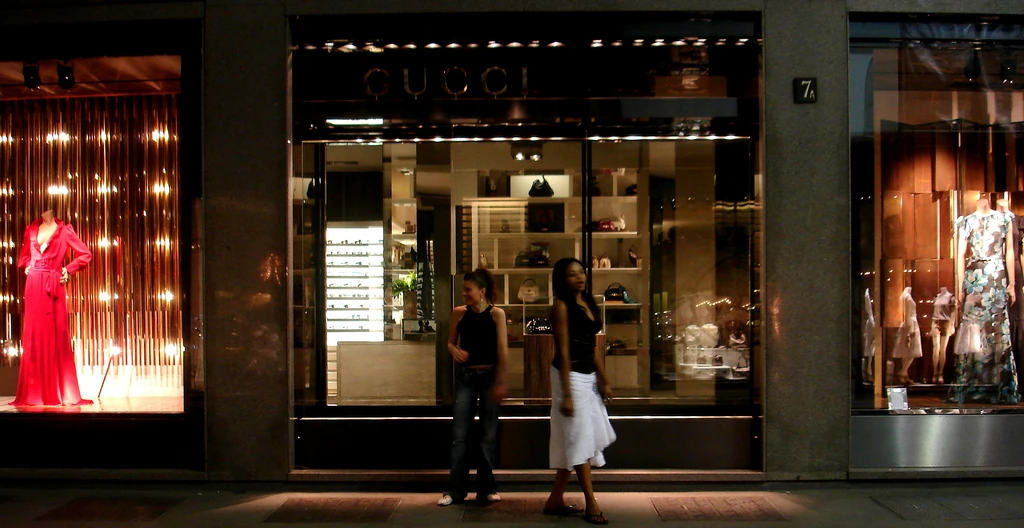
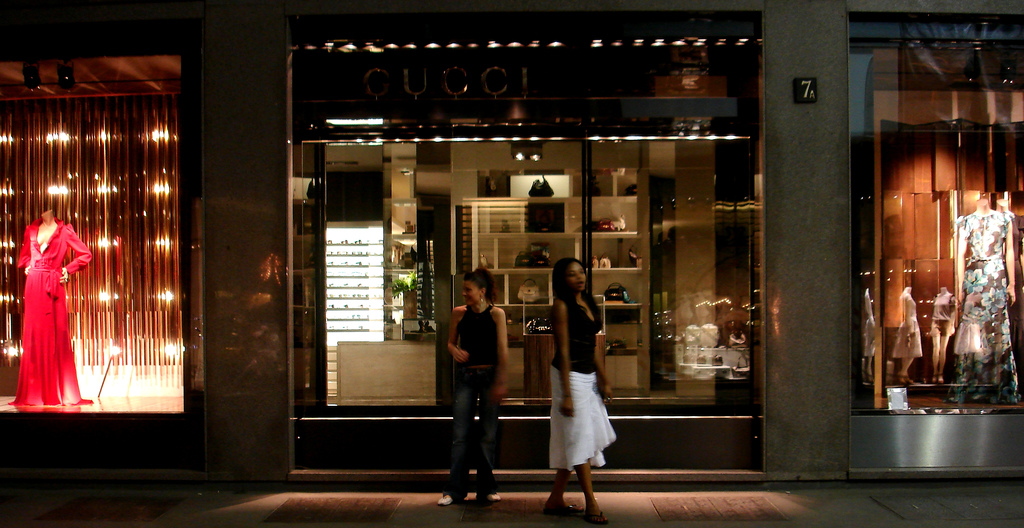
Gucci generated €2.757 billion in revenue in the first half of 2026, according to Kering, down 9% as reported and 5% on a comparable basis. Sales through directly operated stores fell 6% on a comparable basis.
The second quarter was more encouraging. Gucci revenue declined 2% on a comparable basis, while directly operated retail sales also declined 2%. That retail result was seven percentage points better than the first quarter.
The direction improved. The sign was still negative.
Those results cover a period before The Store Show. The September runway cannot explain first-half sales. What it can do is show how Gucci is choosing to present the next phase of its reset while the business is moving, cautiously, in a better direction.
The Product Is Becoming the Point
The more revealing part of Demna’s Gucci is not a single look. It is the repeated focus on making the house easier to recognize at product level.
That focus is showing up behind the runway as well. Demna created an on-site atelier to speed physical development, has talked openly about defining a recognizable Gucci silhouette and has worked on a core wardrobe he calls GucciCore: staples customers can reliably find in a Gucci shop. The reset is increasingly being built around what a customer can actually wear, carry and encounter in a store.
His recent interviews describe a process grounded in the Gucci archive, faster physical development and a sharper sense of silhouette. The common thread is practical: turn a century of house codes into objects that feel current without becoming anonymous.
That is harder than producing one memorable runway. Gucci needs bags, shoes and clothes that can carry the new identity without a paragraph of explanation beside them.
Demna’s February collection had already established the broad change in mood: more glamour, more confidence and a clearer return to familiar Gucci codes. The September collection makes the question more concrete: can those codes become a repeatable language rather than a successful season?
Retail Was in the Reset From the Beginning
There is a useful check on any temptation to call this a sudden pivot.
In September 2025, The Guardian reported that 37 looks from Demna’s La Famiglia chapter were made available immediately in 10 Gucci stores. Retail proximity was already part of the reset before a runway carried the word “store” in its title.
That makes the current moment more coherent. The pattern is not “Demna discovers commerce.” It is archive first, clearer product, faster development, stronger character, then a shorter path between reveal and purchase.
The Store Show makes that pattern unusually explicit. Demna staged the collection inside an imagined version of Gucci retail, collapsing some of the distance between the world built for the runway and the world customers will eventually walk into.
The Hard Part Is Making Desire Repeatable
Gucci has no shortage of recognizable material. Horsebits, bamboo handles, loafers, silk, monograms and several very different modern eras are all available to be revived. The scarce resource is coherence.
Demna’s answer so far appears to be less about choosing one historical Gucci than about giving many Guccis a common attitude. That is where silhouette, proportion, fabrication and development speed matter. They are small decisions compared with the drama of a runway, but they are the decisions a customer eventually meets.
This is why Kering’s second-quarter improvement is encouraging without being a verdict. Gucci’s retail decline narrowed sharply. Kering says newer collections and products are gaining traction. The direction is better. The business still has to prove that the improvement can persist across seasons and categories.
A mega-brand cannot live on a creative reset forever. At some point the reset has to become normal operations.
That may be the most useful way to read The Store Show. Not as proof that Gucci has solved its commercial problem, but as an unusually plain reminder of where the test eventually happens.
A runway can make Gucci fascinating for an afternoon. A store has to make Gucci desirable again tomorrow, next month and next season.
Gucci boutique at Yorkdale Mall. Photo: Raysonho / Wikimedia Commons, CC0 1.0. Source
