

Luxury’s 2026 Recovery Is Real. The Numbers Are Much Stranger Than the Headlines.

Share

Luxury has a recovery problem.
Not because there is no recovery. There is.
Bain and Altagamma now expect personal luxury goods to grow 2% to 4% in 2026 after two years of contraction, putting the market at roughly €365 billion to €373 billion under their base case.
So yes, technically, this increasingly looks like a recovery. The problem begins when recovery gets mistaken for everyone is doing better.
LVMH reported 3% organic growth in the second quarter. Kering reported 2% comparable growth. Richemont, in its quarter ended June 30, reported 20% growth at constant exchange rates.
Those numbers can all be evidence of the same luxury recovery.
That tells you how little the singular word recovery actually explains.
The Top Line Is Better. It Is Also Wildly Uneven.
At LVMH, organic growth moved from 1% in the first quarter to 3% in the second. Fashion & Leather Goods went from a 2% organic decline in Q1 to 1% growth in Q2. Watches & Jewelry accelerated from 7% to 11%. Selective Retailing moved from 4% to 6%.
Kering improved too. The group went from flat comparable growth in the first quarter to 2% in the second. Fashion & Leather Goods improved from a 3% comparable decline to flat. Gucci’s directly operated retail business moved from a 9% decline in Q1 to a 2% decline in Q2.
That last number may be the cleanest snapshot of 2026 luxury.
A seven-point improvement is meaningful.
A negative two is still a negative two.
Richemont makes the contrast harder to ignore. Its sales rose 20% at constant exchange rates in the quarter ended June 30, helped by 24% growth at its Jewellery Maisons.
Luxury is not moving together. It is producing very different versions of better.
Jewelry Is Where the Recovery Looks Least Theoretical
If you want the cleanest category signal, stop staring at handbags for a moment.
LVMH’s Watches & Jewelry business grew organically by 9% in the first half and 11% in the second quarter.
Kering Jewelry rose 20% on a comparable basis in the first half, while directly operated retail sales were up 28%.
And at Richemont, where Cartier and Van Cleef & Arpels make jewelry central rather than incidental to the business, Jewellery Maisons grew 24% at constant exchange rates in the quarter ended June 30.
Three major groups are showing the same category strength from very different starting points.
That does not prove consumers are abandoning bags for jewelry. It does make the pattern much harder to dismiss as company-specific noise.
A market capable of producing double-digit jewelry growth while parts of fashion and leather remain fragile is not a market moving in one direction.
The money is still there. It is becoming more particular about where it lands.
Leather Goods Are Improving From a Bruise
The phrase leather goods are weak is useful only until you look inside the category.
LVMH’s Fashion & Leather Goods division returned to slight organic growth in the second quarter at 1%, after declining 2% in Q1. First-half organic revenue was still down 1%.
Kering’s Fashion & Leather Goods division was flat on a comparable basis in Q2. Gucci improved sharply but remained down 2% for the quarter.
And yet some brands competing inside the same broad category are doing much better.
Within Kering, Saint Laurent returned to growth in the first half and Bottega Veneta continued to outperform, with Kering specifically pointing to leather goods as a source of strength. LVMH described Loro Piana as delivering another excellent performance and Rimowa as posting strong first-half growth. Prada brand retail sales rose 3.3% at constant exchange rates in the first half and accelerated to 6.3% in Q2.
The split is happening twice: between categories, and between brands competing inside the same category.
That is more interesting than jewelry good, handbags bad.
It suggests consumers are not simply retreating from expensive fashion objects. They are becoming more selective about which expensive fashion objects feel urgent enough to buy.
North America Is Doing Disproportionate Work
The geography refuses to behave too.
At LVMH, U.S. growth accelerated from roughly 3% in the first quarter to 6% in the second, according to the company’s earnings commentary reported at the time.
Kering described North America as a key growth driver for Gucci.
Richemont’s Americas sales rose 27% at constant exchange rates in its quarter ended June 30.
Bain’s wider market view also puts the Americas at the front of the 2026 recovery, while describing China as a more cautious recovery and Europe and the Middle East as softer.
That is a very different luxury map from the one the industry spent much of the previous decade learning to depend on.
Mainland China is improving in places, but Kering still describes the market as challenging for Gucci.
Luxury can look healthier in New York, tentative in Shanghai and merely stable elsewhere.
That is not a flaw in the recovery story. It is the recovery story.
What the Numbers Actually Say
| 2026 signal | LVMH | Kering | Richemont |
|---|---|---|---|
| Latest quarterly growth | +3% organic Q2 | +2% comparable Q2 | +20% constant FX, quarter ended June 30 |
| Strongest category signal | Watches & Jewelry +11% Q2 | Jewelry +20% H1 comparable | Jewellery Maisons +24% |
| Fashion / leather signal | Fashion & Leather Goods +1% Q2 | Fashion & Leather Goods flat Q2; Gucci -2% Q2 | Other businesses, including Fashion & Accessories, +9% |
| Geography | U.S. accelerated | North America a key driver | Americas +27% |
| Profit / efficiency signal | H1 recurring operating margin 22.5% | H1 recurring operating margin 12.8% | Different fiscal calendar; not directly comparable here |
The table is less dramatic than a comeback narrative. It is also more useful.
Getting Healthier Is Not the Same as Selling More
Part of the 2026 story is operational.
Kering closed 84 net stores in the first half after 75 closures in 2025, while its recurring operating margin improved to 12.8%.
Its balance sheet also looks dramatically cleaner: net debt fell from €8.0 billion at year-end to €3.3 billion. But that drop needs context. The completed sale of Kering Beauté to L’Oréal generated €4 billion in cash. First-half free cash flow also included €497 million of real-estate proceeds and €300 million related to the Gucci Beauty agreement.
So the lower debt is real. It is not simply evidence that the stores suddenly became far more profitable.
LVMH presents another useful accounting wrinkle. The group posted 2% organic growth in the first half while reported revenue fell 3%, largely because currency movements were strong enough to change what the same underlying activity looked like once translated into euros.
That is why organic, comparable and reported cannot be treated as interchangeable versions of the same number.
In plain English: the businesses can improve operationally while exchange rates and one-off transactions make the headline accounts look either better or worse.
Luxury Is No Longer Enough
This is the more interesting change hiding inside the earnings releases.

In the easiest years of the post-pandemic cycle, a powerful sector tailwind could make a lot of companies look clever at the same time. 2026 looks less forgiving.
Jewelry is strong. North America is doing more work. Some fashion houses are outperforming inside categories that still look soft at group level. Gucci is improving without yet being healthy. China is recovering without restoring the old growth map.
Simply participating in luxury is no longer enough to inherit the sector’s growth.
Demand has become more selective, which means brands have to create more of the urgency themselves.
Being expensive is not the recovery strategy.
Being wanted is.
And September Is Already Complicating the Story
There is a reason not to draw a straight line from the second quarter through the rest of the year.
Bank of America analysts said in early September that industry data for the third quarter pointed to luxury demand slowing by roughly three percentage points versus the second quarter, with weakness showing up across several markets.
That does not erase the first-half improvement. It does protect the word recovery from becoming a prediction.
Stabilization and uninterrupted acceleration are not the same thing.
So, Is Luxury Actually Recovering?
Yes, but the useful part of that answer comes after the comma.
Bain’s market outlook is positive again. LVMH accelerated. Kering returned to comparable growth. Gucci’s declines narrowed. Richemont is growing at a radically different pace. Jewelry is strong. North America is carrying more weight.
What has not returned is the idea of luxury as one giant growth trade in which categories, regions and houses rise together.
A 2% Kering, a 3% LVMH and a 20% Richemont can all be called evidence of the same recovery.
That is precisely why the recovery is the wrong mental picture.
Luxury is getting healthier.
It is also sorting itself.
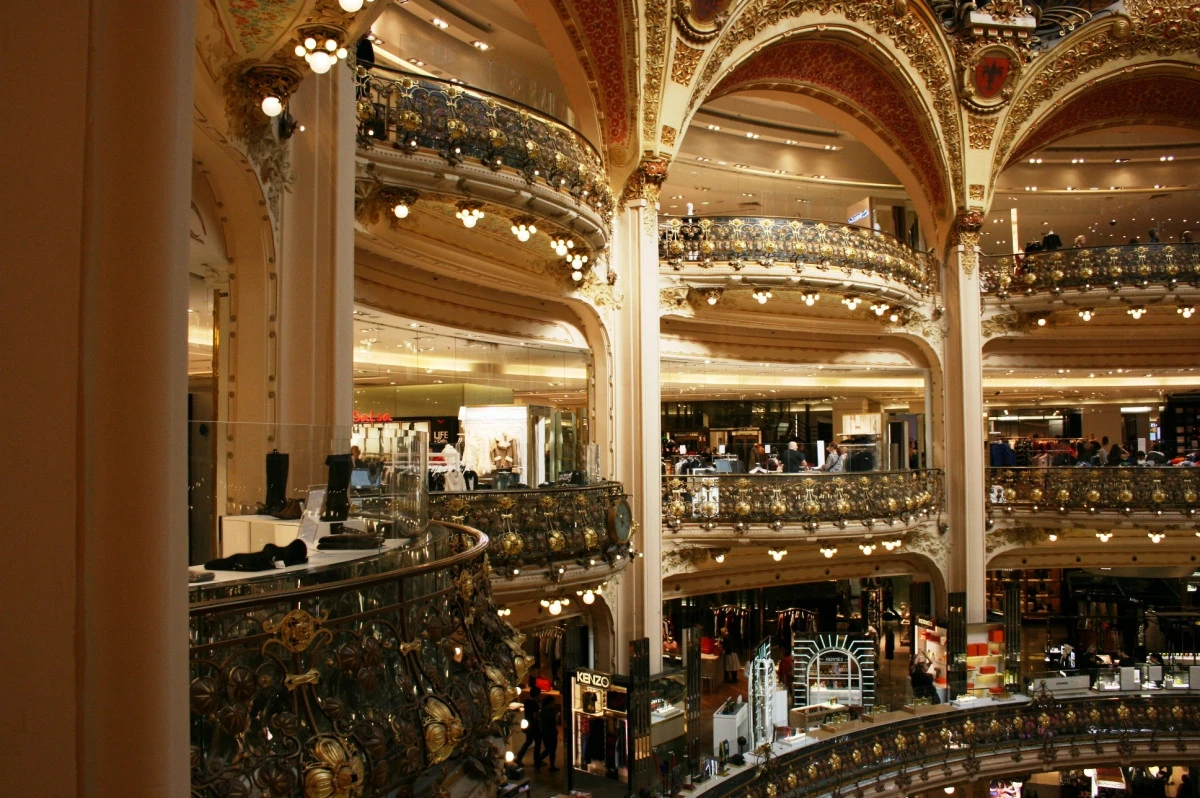
Galeries Lafayette, Paris. Photo: Alex Liivet / Wikimedia Commons, CC0. Source
.jpg)