

Share

Chanel 31 Le Rouge. Image: Chanel via Wallpaper*. Source.
Chanel spent four years engineering a glass case for 31 Le Rouge. Hermès, Guerlain and Dior have their own theories about why the lipstick tube should outlive the color inside it.
Luxury beauty has always had a small disposal problem of the emotional kind. There are compacts that feel too handsome for the bin, perfume bottles that remain on dressing tables long after the last useful drop, boxes that survive house moves because throwing them away seems somehow more decisive than it should.
Refillable lipstick turns that hesitation into the product design.
Chanel’s 31 Le Rouge costs $198 in the United States. Use up the color and the house does not expect you to start over: the next bullet is $98; the glass stays.
Chanel spent four years making that arrangement plausible. The faceted square case is inspired by the mirrored Art Deco staircase at 31 rue Cambon. Sylvie Legastelois, the house’s longtime head of packaging design, worked with a Japanese master glassmaker on a case that could be thin and light enough for a handbag while still durable enough to survive one. Chanel even supplies a quilted black sleeve to protect it.
That is a remarkable amount of architectural anxiety for something whose traditional job is to stop lipstick from marking the inside of a handbag.
It also explains what is unusual about the $198 proposition. 31 Le Rouge is selling color, certainly, but it is also selling a small piece of rue Cambon with a replaceable center.
Refillable lipstick was luxury before it was virtuous
The surprise is that none of this is as new as contemporary beauty language makes it sound.
When Dior revisited Rouge Dior in 2021, makeup creative director Peter Philips reminded British Vogue that Christian Dior’s original 1953 lipstick was refillable too. There was an objet d’art version for the dressing table, another for the handbag, and department-store counters stocked with replacement colors.
Before refillability became a sustainability claim, it was already a luxury idea: buy the beautiful object, then replenish the part designed to disappear.
Which raises a more interesting question than whether a refill saves a bit of packaging.
Instead of asking consumers to care more about packaging, what if you make packaging they care too much about to discard?
Research on product attachment has been exploring that problem for years. The basic observation is intuitive: objects that become meaningful tend to be kept longer. The useful part for luxury is what can make them meaningful in the first place: beauty, specificity, ritual, memory, identity, the sense that this particular object is not quite interchangeable with another one.
That does not prove that a glass Chanel lipstick case is a sustainability strategy. It does suggest that luxury has an unusually relevant skill set. These houses already know how to make a container feel less like a container and more like something one might notice, protect, display and miss if it disappeared.
Obligation asks you to keep the packaging because throwing it away would be wasteful. Attachment gives you a more selfish reason: you actually want the thing.
There is, naturally, a catch.
A 2022 International Journal of Design study by Kowalski and Yoon found that emotionally important objects were not always used more. Sometimes people protected the cherished thing and bought something else to do the practical job. In other words, keeping an object is not the same as reducing consumption.
Luxury, an industry exceptionally talented at making us want the next beautiful thing too, should probably keep that footnote close.
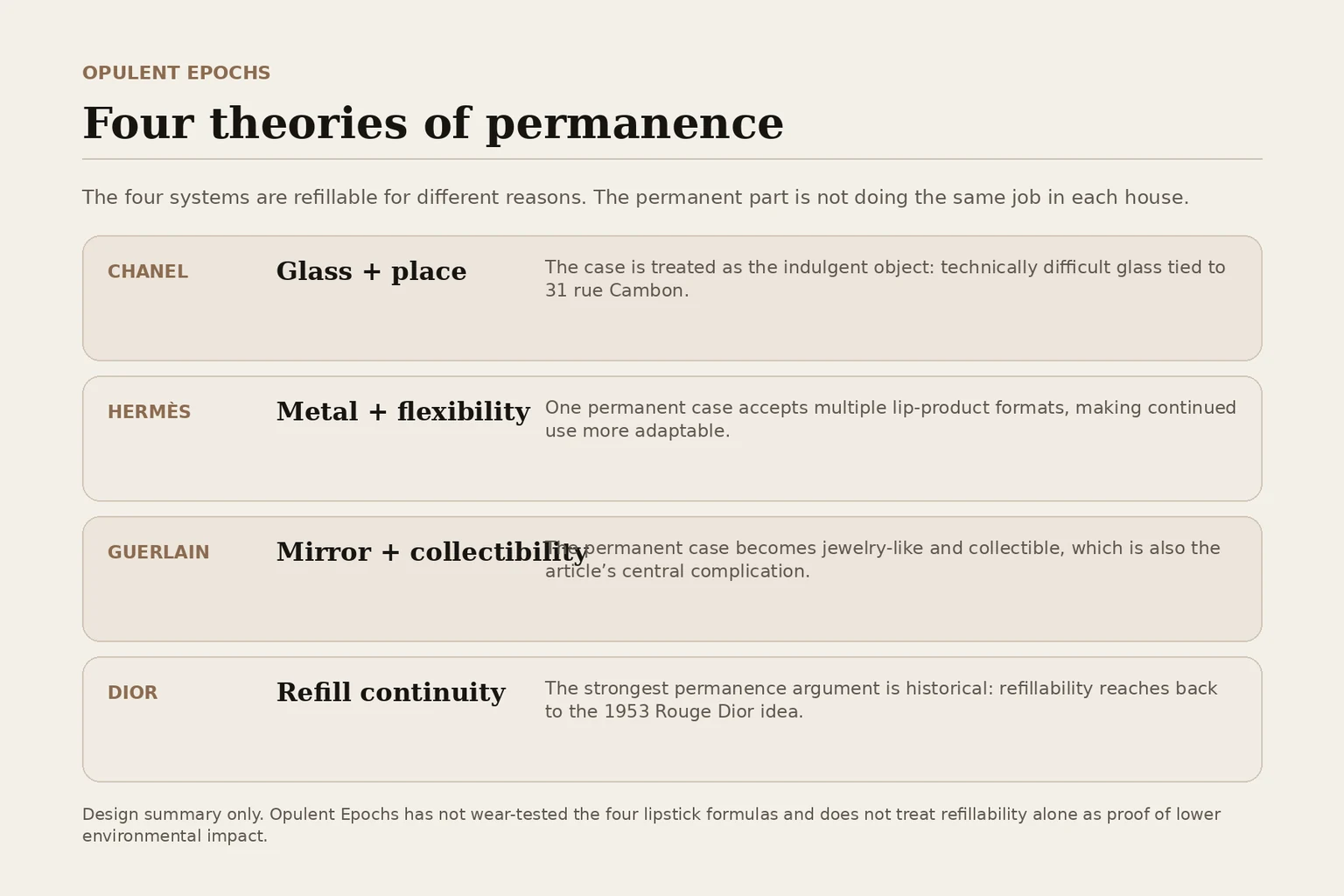
Today’s refillable lipstick systems make the tension unusually visible. Chanel makes the case an address. Hermès makes it a métier. Guerlain makes it jewelry, and collectible jewelry at that. Dior, perhaps most intriguingly, makes the old idea relatively easy to enter.
Chanel makes the case the object
By this point, the staircase, the glass and the protective sleeve have already established that 31 Le Rouge is not treating the outer case as incidental packaging. The more interesting question is what all that specificity does once the lipstick belongs to someone.
A generic tube is easy to replace without ceremony. A case tied to a famous address, engineered over four years and delicate enough to come with its own sleeve gives the owner something more particular to lose.
A replacement color is $98, compared with $198 for the initial lipstick. The first purchase therefore only makes emotional sense if the glass architecture is part of the pleasure.
This is where attachment stops sounding like an academic design term. If the case feels particular enough that you would be annoyed to lose it, Chanel has given the refill a behavioral advantage before anyone has mentioned recycling.
Hermès made lipstick its sixteenth métier
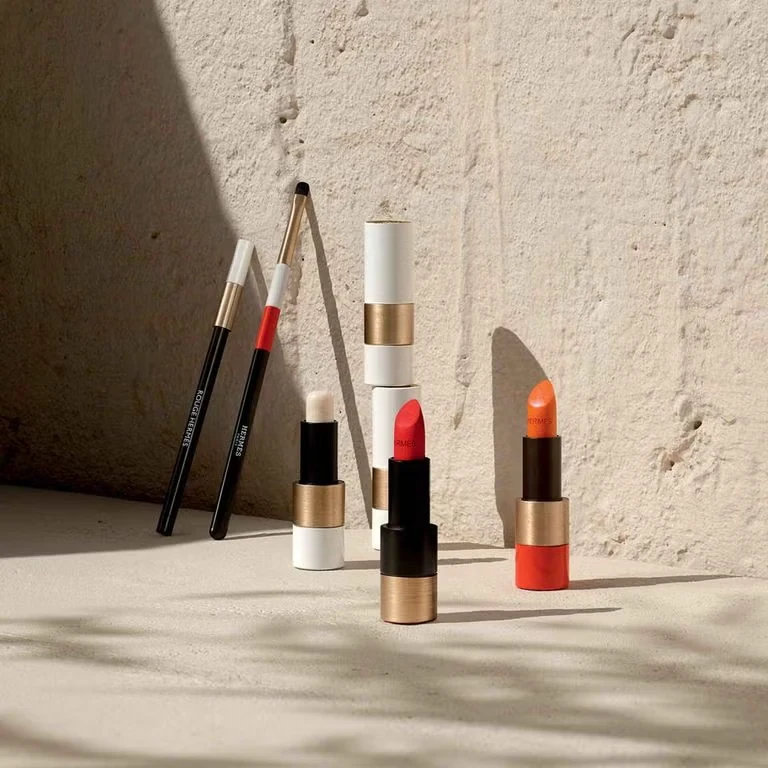
Rouge Hermès arrived in 2020 as the house’s first makeup collection and its sixteenth métier. The project drew on several house disciplines, including Pierre Hardy, who designed the lipstick object itself in polished, brushed and lacquered metal.
The tube references the Hermès Ex-Libris, arrives with a canvas pouch, and slips into the orange box. Even Rouge H, one of the colors, carries older house history: the dark red was created for Hermès leather in 1925.
The cleverest detail is less visible. A standard $56 Rouge Hermès refill can go into the same $86 case whether the buyer wants matte lipstick, satin lipstick, lip care balm or lip shine.
The case is therefore not married to one finish or even one kind of lip product. Hermès has made the part that remains more flexible than the part that disappears.
That flexibility may matter as much as preciousness. A permanent object has a better chance of actually staying in use if it can survive a change of mood.
Guerlain gave the job to a jeweller
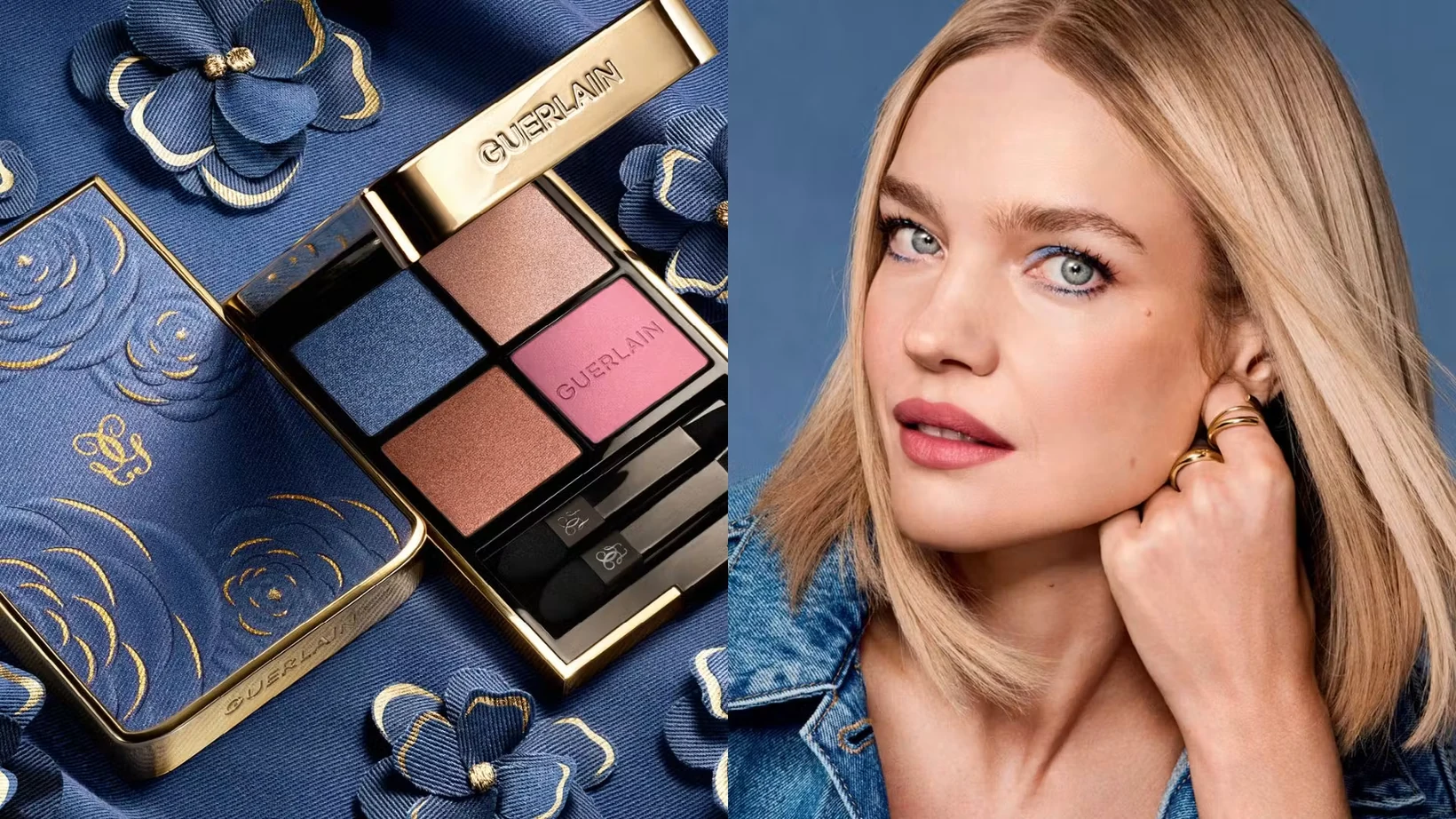
Rouge G makes perhaps the least subtle argument for treating lipstick as jewelry, because a jeweller actually designed it.
Lorenz Bäumer created the distinctive case in 2009: a rounded, inverted-ingot form that opens to reveal a built-in double mirror. Guerlain later made the system customizable, and the current line turns the case itself into a rotating wardrobe of crocodile effects, marbling, Art Deco patterns, limited blues and other finishes.
The standard economics are almost perversely reasonable beside Chanel. A current Rouge G refill is $44; a standard case is $43. That puts the basic first configuration at $87, with the option to keep the same mirror case and replace only the color, or, naturally, sabotage the efficiency exercise by deciding that this season’s case is prettier.
And here the attachment argument begins eating its own tail.
One beautiful case carried through five lipstick refills is easy to understand as a less disposable system. Five beautiful cases because the tortoiseshell one looked lonely beside the Art Deco one is a more complicated environmental story.
That does not make Rouge G hypocritical. It makes it interesting. Guerlain calls the case a collector’s accessory and has spent years giving it reasons to multiply. The same emotional attachment that can make an object worth keeping can also make another object worth acquiring.
Refillability here does not necessarily mean owning less. It can mean collecting the part you no longer have to throw away.
Dior was doing this in 1953
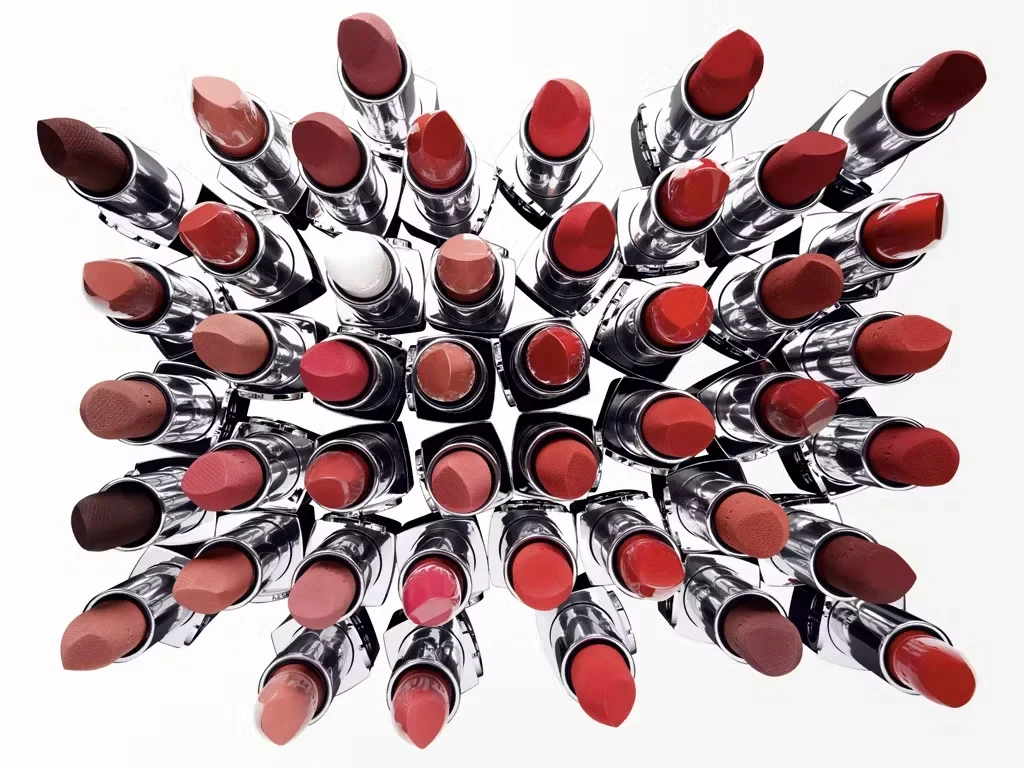
Rouge Dior is the least expensive way into the main comparison at $50, with current refills at $40.
The outer case carries familiar Dior codes, including Cannage and a silver-colored CD band, and the brand describes it as something designed to be kept while the color cartridge changes.
But the strongest thing Dior has going for it is historical continuity. Peter Philips’s account of the 1953 original makes the current model feel less like a new sustainability feature than the return of an old luxury habit.
The lipstick may have changed. The proposition is remarkably familiar: choose the holder you want to live with, then replace what runs out.
Dior also shows how far that idea can be pushed. At a completely different tier sits Rouge Premier: a current $530 lipstick built around a ceramic and 18K-gold-dipped metal case created with French porcelain house Bernardaud. Its replacement lipstick is $65. Rouge Premier does not belong in the baseline price table below, but it makes one thing very clear: at the top end of beauty, the case can stop behaving like packaging altogether.
So Dior holds both ends of this particular argument: the $50 refillable lipstick and the $530 object designed to be kept.
The price of staying in the system
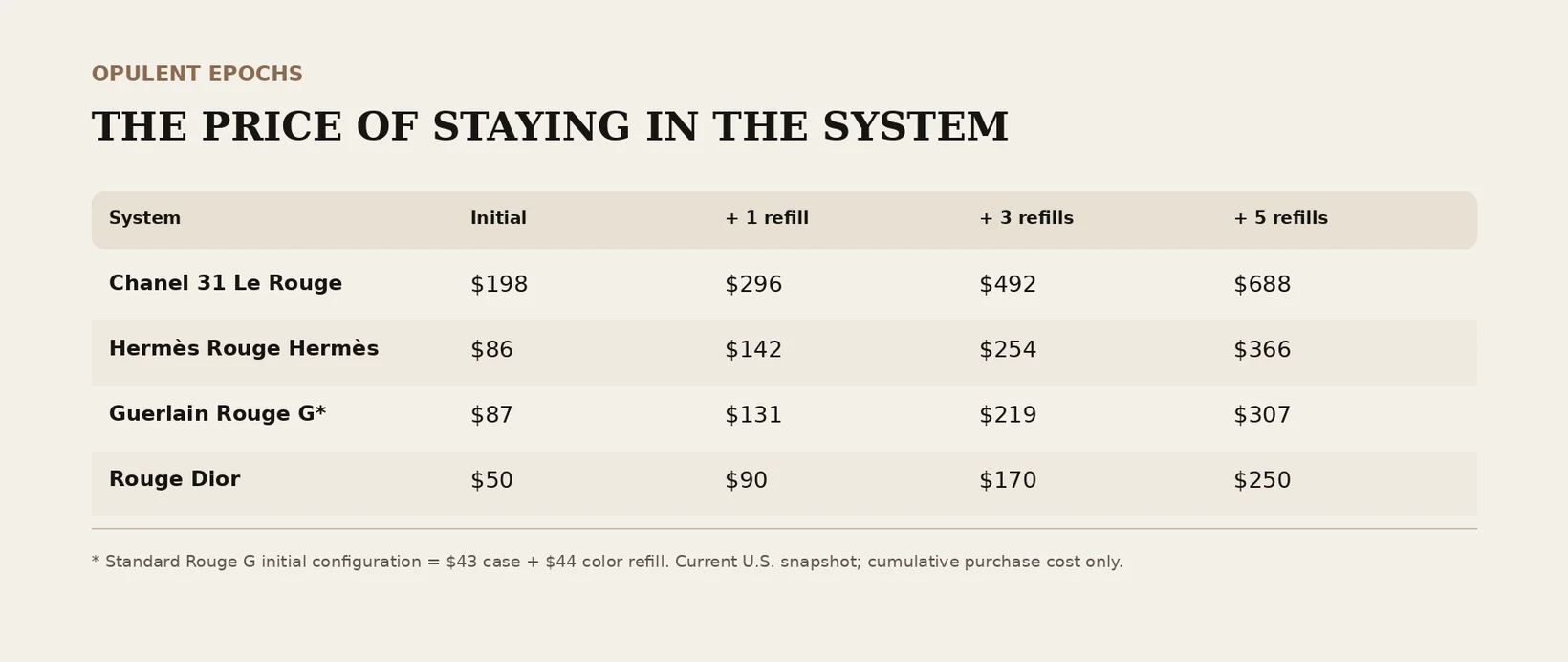
Current US pricing turns the four mainline systems into very different long-term bills.
| System | Initial purchase | Initial + 1 refill | Initial + 3 refills | Initial + 5 refills |
|---|---|---|---|---|
| Chanel 31 Le Rouge | $198 | $296 | $492 | $688 |
| Hermès Rouge Hermès | $86 | $142 | $254 | $366 |
| Guerlain Rouge G* | $87 | $131 | $219 | $307 |
| Rouge Dior | $50 | $90 | $170 | $250 |
*Standard Rouge G calculation uses a $43 case plus a $44 color refill for the initial configuration.
Those numbers cannot tell us which lipstick formula is better, and we have not wear-tested the four systems side by side. They tell us something narrower and, for this story, more useful: the price of continuing the relationship.
Five refills widen what initially looks like a familiar luxury-price spectrum into something more consequential: continuing with Chanel costs nearly three times as much as continuing with Dior. The refill may be the disposable component, but loyalty to the system has a price of its own.
What Actually Gets Kept
If the decision is purely financial, Rouge Dior is the easy answer among the four mainline systems. It has the lowest entry price and the lowest current refill price.
But the cases are not pretending to be interchangeable.
Chanel makes a strong argument that the container itself is the indulgence: glass, technically difficult, tied to a specific address and protected accordingly. Hermès offers the most flexible system, with one metal object accepting several kinds of lip product. Guerlain makes the case the collectible pleasure, complete with mirror and seasonal personality. Rouge Dior asks for the lightest financial commitment while carrying the longest refill history; Rouge Premier shows the same house taking permanence to its almost absurdly literal conclusion.
The wrong purchase is therefore not automatically the most expensive one. It is the case you admire for a week and never refill.
Or, perhaps, the six cases you adore so much that the supposedly permanent part becomes a collection of its own.
That is why the behavioral idea underneath refillable luxury is more interesting than the usual moral instruction to waste less. Luxury does not need to make us virtuous to make us keep something. It can make the keeping pleasurable.
The research suggests attachment can help objects remain with us longer. It also warns that attachment alone does not guarantee we will consume less. The difference lives in what happens next: whether the object stays useful through refill after refill, or simply becomes one more beautiful thing we could not resist owning.
Luxury has always been very good at making packaging too lovely for the bin.
The more interesting question is whether it can make us love one case enough to stop needing another.
Featured image: Original Opulent Epochs editorial graphic. Brand-neutral illustration; not a Chanel, Hermès, Guerlain or Dior product image.